
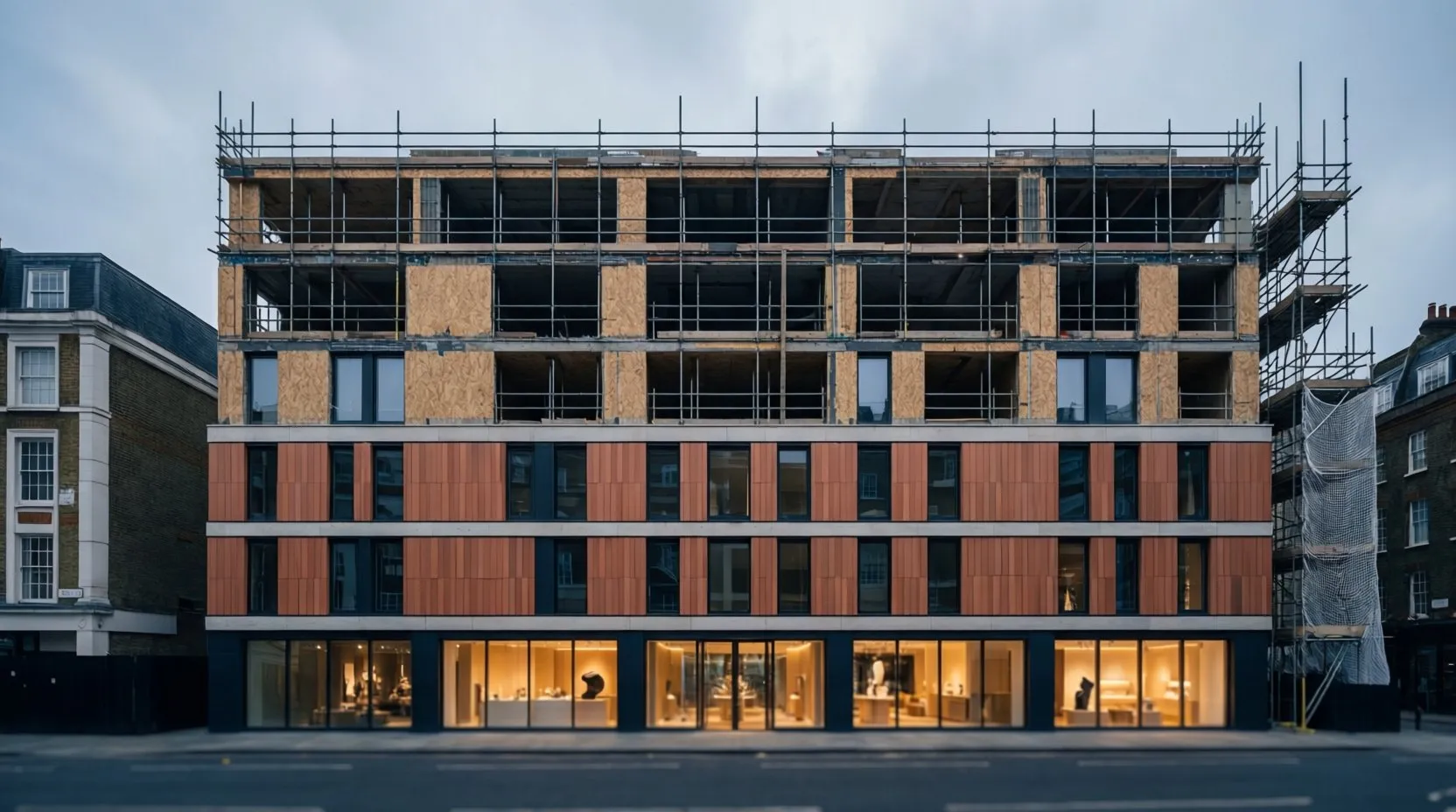
Cladding and the wider external wall system affect commercial property insurance because they can change how quickly a fire spreads, how much of a building is damaged, and how long it stays out of use. Insurers price and accept risk on that basis, so the materials on the outside of your building can shape whether cover is offered, on what terms, and at what premium.
Since the Grenfell Tower tragedy in June 2017, insurers may ask cladding insurance questions about many buildings, not only tower blocks. If you own or manage a let building, understanding your building's external wall system is now part of arranging commercial property insurance properly. This article sets out why, what has changed in building safety regulations, and the practical steps property owners can take before renewal.
Key Takeaways
- Insurers assess the external wall system as a whole: cladding panels, insulation, cavity barriers, balconies, windows and doors.
- The Building Safety Act 2022 created a stricter regime for higher-risk buildings, and a ban on combustible materials applies to the external walls of certain buildings with a storey at least 18 metres high.
- Mixed-use buildings with flats above commercial space can fall within these rules even where the owner thinks of the building as commercial.
- Cladding can affect which insurers will quote, the terms they apply and the premium, and it can extend the time a building is out of use after a fire.
- A buildings policy is generally designed to respond to sudden insured damage, not to pay for correcting how a building was built, so remediation costs are a separate question from your property cover.
- Good information, such as a fire risk appraisal of the external walls, helps underwriters make decisions on evidence rather than assumption.
General Information
This article is for information only and does not constitute advice on any particular policy. Insurer appetite, terms and wordings vary, and the terms that apply to your property are those set out in your own policy. Before relying on anything here, check your wording or speak to a qualified broker who can look at your circumstances.
What Is an External Wall System?
An external wall system is everything that makes up the wall between the inside of a building and the outside. Government guidance explains that, under Building Regulations, the external wall includes the cladding, anything within the wall such as insulation, and any windows, doors and balconies.
That matters because insurers are not only interested in the visible face of the building. A brick-effect finish can sit over combustible insulation. A panel that looks like metal can have a combustible core. Missing or poorly fitted cavity barriers can let fire travel unseen behind an otherwise sound facade.
Common cladding materials you may see in survey or underwriting questions include:
- Aluminium composite material (ACM) panels, the type of material at the centre of the Grenfell Tower fire
- High-pressure laminate (HPL) panels, whose fire performance depends on their classification
- Timber cladding and timber-framed external walls
- Rendered insulation systems
- Metal sandwich panels with insulated cores
- Brick slips fixed over insulation
The fire performance of each depends on the specific product, how it was installed and what sits behind it. Two buildings with similar-looking cladding can present very different risks.
Why Insurers Look Closely at Cladding
Insurers are pricing the chance of a loss and how large that loss could be. External cladding systems can affect both.
Where combustible materials form part of the wall, a fire that starts in one unit or at ground level may spread up or across the outside of the building. That can turn a contained incident into damage across several floors, with a longer and more complex rebuild. For a landlord, that can also mean a longer period without rental income.
Underwriting decisions on clad buildings usually turn on the quality of information available. An underwriter may ask:
- What the cladding and insulation are, and what proportion of the walls they cover
- Whether a fire risk assessment or a more detailed external wall appraisal has been carried out
- Whether remedial works are planned, under way or complete
- What interim fire safety measures are in place, such as alarms or detection
- The building's height, use and occupancy
- The building's claims history
Where the answers are unclear, some insurers offering commercial let property insurance may decline or apply restrictive terms rather than quote on an assumption. Complex risks like these are where an experienced insurance broker earns their place, because presenting the building accurately and completely gives each insurer a fair basis to decide.
The Regulatory Background: Building Safety Act 2022 and the Combustible Materials Ban
The insurance market's view of cladding has developed alongside significant regulatory changes.
The Ban on Combustible Materials
From 21 December 2018, Building Regulations restricted the use of combustible materials in the external walls of certain new high-rise buildings. The government's guidance on the ban on combustible materials explains that it covered new blocks of flats, hospitals, residential care premises and student accommodation over 18 metres, and that its scope has since been extended. It does not apply to every building type, so check the guidance for the uses it covers.
The Building Safety Act 2022
The Building Safety Act 2022 introduced a new regime for higher-risk buildings in England. For the occupation phase, a higher-risk building is defined in section 65 of the Act as one that is at least 18 metres in height or has at least seven storeys, and contains at least two residential units. The Building Safety Regulator oversees these buildings.
Fire Risk Assessments and External Walls
The Fire Safety Act 2021 made clear that fire risk assessments for buildings with two or more sets of domestic premises must take account of the external walls, including cladding, balconies and windows. Where a fire risk assessment raises concerns, a specialist may carry out a fire risk appraisal of external walls (FRAEW) using the PAS 9980 methodology. Government guidance published in September 2026 confirms that PAS 9980:2026 replaces the 2022 version, and that an FRAEW completed under the 2022 version should remain valid until it needs to be reviewed.
The same guidance notes that an EWS1 form is not a government document or a safety certificate. Mortgage lenders and valuers may request one, but it does not replace an FRAEW.
Why This Matters for Commercial and Mixed-Use Buildings
Much of the building safety regime is aimed at residential properties. That does not mean commercial property owners can set it aside.
Many investment properties combine uses. A building with shops or offices on the lower floors and flats above can meet the higher-risk building definition if it reaches the height or storey threshold and contains at least two residential units. Owners who hold mixed portfolios under property owners insurance should check each building against the definitions rather than assume a commercial ground floor takes it out of scope.
For purely commercial buildings that sit outside these regulations, insurers may still ask about external wall construction. Building regulations set the legal minimum, while insurers decide for themselves what risks they are willing to accept. An office or industrial unit clad in insulated panels may attract questions about fire performance whether or not a regulation applies to it.
The same thinking applies across insurance for commercial let property, from single retail units to larger estates. The construction of the walls is part of the risk exposure the insurer is being asked to take on.
Cladding Insurance: How External Walls Affect Terms and Claims
Cladding risks can show up in your insurance arrangements in several ways, and cladding insurance questions may come up at renewal even where nothing about the building has changed.
Availability and Premiums
Buildings with known or suspected combustible cladding may be harder to place. The Financial Conduct Authority looked at this market for blocks of flats in its 2022 report, and its rules on multi-occupancy building insurance came into force on 31 December 2023 to improve outcomes for leaseholders. Any change in premium reflects the insurer's assessment of the risk, and better information can help that assessment.
Terms and Conditions
An insurer may apply specific terms to a clad building, such as a higher excess for fire, requirements around fire detection, or conditions linked to completing remedial works. Read these carefully. How a condition is drafted affects what happens if it is not met at the time of a loss.
Loss of Rent and Business Interruption
If fire spreads across a facade, the building may be out of use for longer than if the fire had been contained. Loss of rent cover pays rent lost after insured damage makes the property unusable, and business interruption cover pays the lost income of a business that occupies its own premises. In both cases, the indemnity period you select should reflect how long a complex rebuild could realistically take.
Telling Your Insurer About Changes
If you discover that your building has cladding you were not aware of, or a new assessment changes what you know about it, talk to your broker. Telling your insurer about a change does not in itself void your policy. It gives the insurer the opportunity to re-rate the risk, add terms or decline, and it puts the information on record before any claim.
What a Property Policy Is Not Designed to Do
Cladding remediation is the work of correcting a building's construction. A buildings policy is generally designed to respond to sudden damage from insured events, not to pay for correcting a defect in how a building was designed or built. Funding for remediation is a separate matter, and for eligible residential buildings the government's Cladding Safety Scheme is one route. Check your own wording rather than assuming either way.
Remediation Work and Your Insurance Arrangements
Remediation work brings its own insurance considerations, and it is worth planning them before contractors arrive on site.
- Tell your insurer before works start. Scaffolding, hot works and partly stripped facades can change the risk. Your policy may require you to notify the insurer of building works, and the insurer may apply terms while they are under way.
- Check the contractor's cover. Contractors carrying out cladding projects should hold suitable liability and contract works cover. Firms of this kind often arrange building contractors insurance to cover their own exposure on site.
- Consider professional indemnity. Designers, fire engineers and assessors involved in external wall work typically need professional indemnity insurance, so ask to see evidence of their cover and check whether it limits or excludes cladding and fire safety work.
- Plan for vacancy. If tenants move out while work is carried out, the building may become unoccupied for policy purposes, which can change the terms of your cover. Unoccupied commercial property insurance is designed for buildings that stand empty for extended periods.
Weather protection matters too. A facade that has been partly removed can expose the structure to rain and wind, so ask how the contractor will protect the building between stages.
Practical Steps for Commercial Property Owners
Whether or not your building is a higher-risk building, a few practical steps make your cover for commercial property easier to arrange and easier to rely on.
- Find out what is on your walls. Gather any construction drawings, building control records, fire risk assessments and external wall appraisals you hold.
- Check whether the building is in scope. Measure the building against the higher-risk building definition, particularly for mixed-use properties.
- Keep fire risk assessments current. Where the building contains two or more flats, the responsible person must make sure the assessment covers the external walls.
- Record fire safety measures. Keep dated records of alarm servicing, detection systems and any interim measures.
- Plan remediation and insurance together. Speak to your broker before works start, not afterwards.
- Review your sums insured and indemnity periods. A building with complex external walls may take longer and cost more to reinstate.
Arranging Cover With Ellis David
We have arranged property insurance from our office on Essex Road in Islington, London, for over 50 years, and our team has 150+ years' combined experience.
We work with 100+ UK insurers and specialist underwriters, which gives us a wide range of insurers to approach for clad buildings. We can take time to understand your building, read your existing wording with you and present the risk to insurers fully, so that each one has a fair basis to quote. Our advisers are UK-based, and we are authorised and regulated by the Financial Conduct Authority.
We also arrange block of flats insurance for freeholders, where external wall information is often central to the risk. You can also meet the team who would handle your property.
If you own a building with cladding, are unsure what your external walls are made of, or have remedial works coming up, speak to our commercial property team about buildings cover for let commercial premises.
Frequently Asked Questions
Does Cladding Affect Commercial Property Insurance?
It can. Insurers assess how a building's external wall system might behave in a fire, because combustible materials can increase the spread and cost of damage. Depending on the materials and the information available, cladding can affect which insurers will quote, the terms they apply and the premium.
What Is Included in a Building's External Wall System?
An external wall system includes the cladding, anything within the wall such as insulation, and the windows, doors and balconies set into it. Cavity barriers and fire-stopping within the wall also form part of how the system performs in a fire.
Does the Building Safety Act 2022 Apply to Commercial Buildings?
The higher-risk building regime in the Building Safety Act 2022 applies, for the occupation phase, to buildings in England that are at least 18 metres tall or have at least seven storeys and contain at least two residential units. A purely commercial building is outside that definition, but a mixed-use building with flats above commercial space can be within it.
Will My Buildings Insurance Pay for Cladding Remediation?
A buildings policy is generally designed to respond to sudden damage from insured events rather than to correct how a building was designed or built, so remediation costs are not usually something a property policy is intended to meet. The answer depends on your own wording, and separate funding schemes exist for some eligible residential buildings.
What Is an FRAEW?
A fire risk appraisal of external walls (FRAEW) is a specialist assessment of the risk of fire spreading through a building's external wall system. In England, it is carried out using the PAS 9980 methodology, and its findings should feed into the building's fire risk assessment.
Is an EWS1 Form the Same as a Fire Safety Certificate?
No. Government guidance states that an EWS1 form is not a government document or a safety certificate. Mortgage lenders and valuers may request one as part of a sale or remortgage, but it does not replace a fire risk appraisal of external walls.
Useful Resources
- GOV.UK, Understanding fire risk appraisals of external walls in blocks of flats: https://www.gov.uk/government/publications/fire-risk-appraisals-of-external-walls-fraews/understanding-fire-risk-appraisals-of-external-walls-in-blocks-of-flats
- GOV.UK, Ban on combustible materials: https://www.gov.uk/guidance/ban-on-combustible-materials
- legislation.gov.uk, Building Safety Act 2022, Part 4: https://www.legislation.gov.uk/ukpga/2022/30/part/4
- GOV.UK, Criteria for being a higher-risk building during the occupation phase: https://gov.uk/guidance/criteria-for-being-a-higher-risk-building-during-the-occupation-phase-of-the-new-higher-risk-regime
- Financial Conduct Authority, PS23/14 Multi-occupancy building insurance: https://www.fca.org.uk/publications/policy-statements/ps23-14-multi-occupancy-building-insurance-feedback-cp23-8-final-rules
- GOV.UK, Cladding Safety Scheme: https://www.gov.uk/government/publications/cladding-safety-scheme